Solving a problem by creating objects is one of the most popular approaches in programming. This is called object-oriented programming.
This concept focuses on using reusable code. (Implements DRY principle)
Class
A class is a blueprint for creating objects.
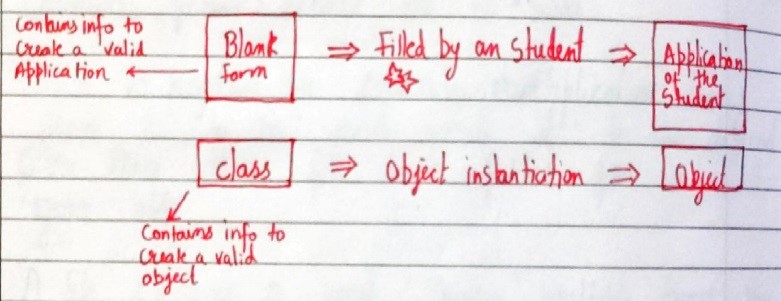
The syntax of a class looks like this:
Class Employee:
[classname is written in PascalCase]
Object
An object is an instantiation of a class. When class is defined, a template(info) is defined. Memory is allocated only after object instantiation.
Objects of a given class can invoke the methods available to it without revealing the implementation details to the user. #Abstraction & Encapsulation!
Modelling a problem in OOPs
We identify the following in our problem
Noun -> Class -> Employee
Adjective -> Attributes -> name,age,salary
Verbs -> Methods -> getSalary(), increment()
Class Attributes
An attribute that belongs to the class rather than a particular object.
Example:
Class Employee:
company = “Google” #Specific to each class
harry = Employee() #Object instantiation
harry.company
Employee.company = “YouTube” #changing class attribute
Instance Attributes
An attribute that belongs to the Instance (object)
Assuming the class from the previous example:
harry.name = “Harry”
harry.salary = “30K” #Adding instance attributes
Note: Instance attributes take preference over class attributes during assignment and retrieval.
harry.attribute1 :
- Is attribute1 present in object?
- Is attribute1 present in class?
‘self’ parameter
self refers to the instance of the class.
It is automatically passed with a function call from an object.
harry.getSalary()
here, self is harry and above line of code is equivalent to Employee.getSalary(harry)
This function getsalary is defined as:
class Employee:
company = “Google”
def getSalary(self):
print(“Salary is not there”)
Static method
Sometimes we need a function that doesn’t use the self-parameter. We can define a static method like this:
@staticmethod #decorator to mark greet as a static method
def greet():
print(“Hello user”)
__init__() constructor
__init__() is a special method which runs as soon as the object is created.
__init__() method is also known as constructor.
It takes self-argument and can also take further arguments.
For Example:
class Employee:
def __init__(self,name):
self.name = name
def getSalary(self):
#Some code…
harry = Employee(“Harry”) #Object can be instantiated using constructor like this!
Chapter 10 – Practice Set
- Create a class programmer for storing information of a few programmers working at Microsoft.
- Write a class calculator capable of finding square, cube and the square root of a number.
- Create a class with a class attribute a; create an object from it and set a directly using object.a=0 Does this change the class attribute?
- Add a static method in problem 2 to greet the user with hello.
- Write a class Train which has methods to book a ticket, get status(no of seats), and get fare information of trains running under Indian Railways.
- Can you change the self parameter inside a class to something else (say ‘harry’)? Try changing self to ‘slf’ or ‘harry’ and see the effects.
 beginner's